5.6 Preparing the natural nail
Now that you have successfully passed your first Major Assignment and demonstrated adequate control of your products and a sound understanding of nail shape and structure, it is time to progress onto working with human hands. Your practice finger and tips are still a very effective training tool and you can absolutely still use them to practice the new techniques that will be covered in upcoming lessons. However, one of the most crucial aspects of a nail enhancement is preparing the natural nail prior to treatment, and clearly this can only be done on a real, human hand.
Correct nail preparation is crucial to ensure your products both adhere to the natural nail, and remain adhered until your client’s next appointment. The longevity of your nail treatments (how long they last) will make or break you as a professional nail technician, and so it is critical you take the time to prepare your client’s natural nails and complete each preparation step EVERY TIME.
As you will recall from earlier theory, nail lifting is the term applied when artificial nails come away from the natural nail plate. Nail lifting can occur with any nail enhancement, however is most common with acrylic and gel enhancements. As mentioned, nail lifting is (almost always) an indicator of a nail service breakdown, and a reputation killer! Below are a couple of examples of nail lifting:
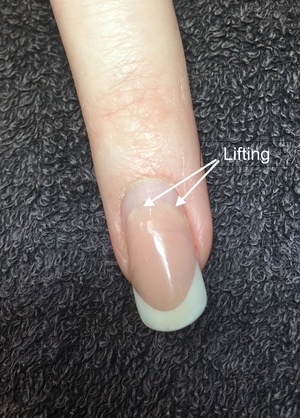
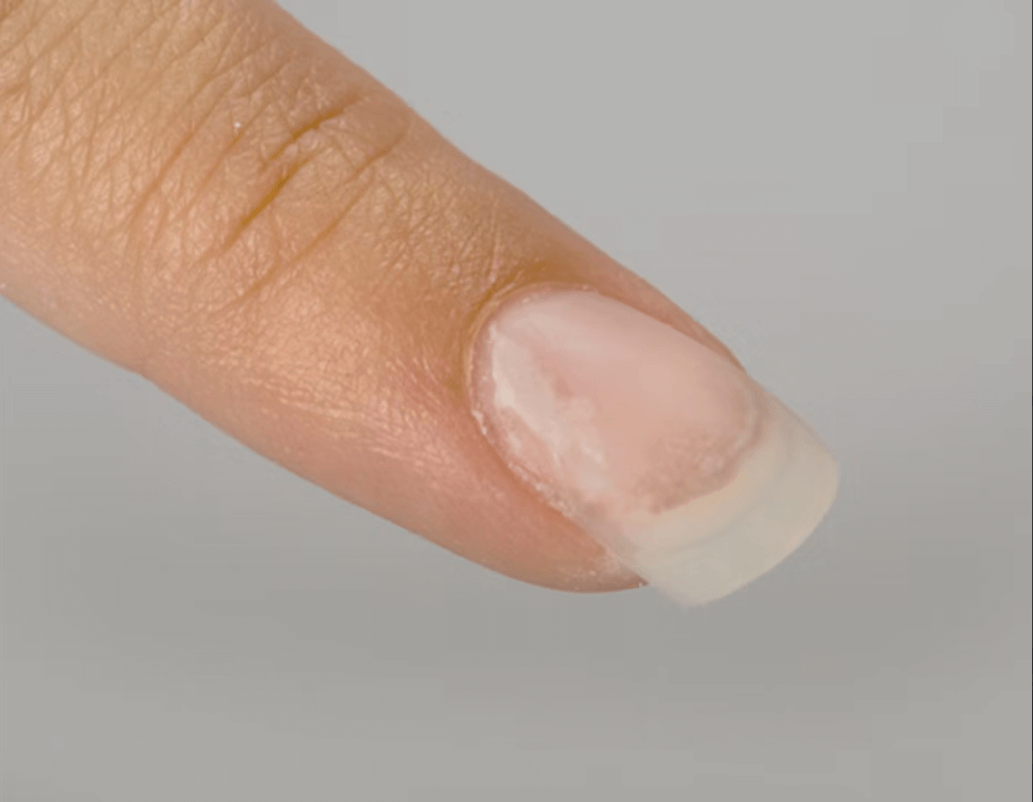
With the above said, a minimal amount of nail lifting can be expected due to wear and tear once the enhancement has grown out and your client is nearing their next appointment. However, regular or substantial lifting around the cuticle area, especially within the first week following a treatment, is abnormal, and the reason for this needs to be investigated and addressed.
The most common reason for nail lifting is, as mentioned, poor preparation of the nail plate due to not preparing (pushing back) the cuticle region properly, or leaving behind some oils or nail dust on the nail plate. Other reasons for nail lifting include:
- Applying product too close to the cuticles
- Over filling the nail plate
- Applying product over a damaged nail plate
Cuticle preparation
Proper cuticle preparation is essential for the health of our nails. As you have learned already, people often think the eponychium is the cuticle (can also be referred to as the live cuticle) and cut this off during a manicure or pedicure process. The eponychium must never be cut! The cuticle is the clear, thin layer that sheds from the eponychium and attaches to the nail plate. As the nail plate grows, the cuticle grows out with it. This is the only part that should be removed or trimmed. This must be done with great care so as to not cut the live eponychium.
When many nail technicians start out, they can be very afraid of working with the cuticle. So long as you take your time and do not cut off any living tissue, cuticle preparation, for the most part, is very simple. Cuticle preparation is of the UTMOST importance, as any residual cuticle left on the nail plate will result in your enhancement lifting.
Cuticle preparation involves the following steps:
Step 1
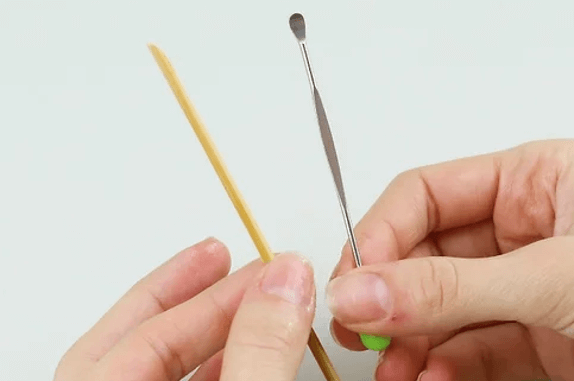
Using a metal cuticle pusher or wooden cuticle stick, hold the tool with a firm yet light grip.
Step 2
Place the edge of the tool against the eponychium that is attached to the nail plate (not at the base) and gently press against it, pushing the skin toward the proximal nail fold.

Step 3
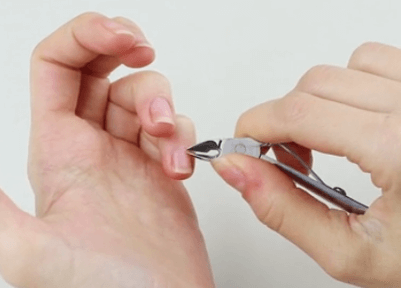
Now that the cuticle is exposed, you can remove the non-living tissue from the nail plate using cuticle nippers.
We will demonstrate how to prepare the cuticles in depth in the next video tutorial.
Shorten and trim the free edge
Using the correct nail trimming technique is also an absolute must to ensure you not damage the natural nail when preparing for the application of a new set of enhancements, or when removing an old set. To trim natural nails in preparation for gel or acrylic nail services, you can use nail clippers and/or nail scissors. When trimming fingernails, it is useful to start by cutting the side at an angle, then the middle, then the other side. If you try to trim the nail straight across in one go, it can actually bend the nail and cause damage. However, when cutting toenails, you should always cut straight across to prevent ingrown toenails.
When trimming your client’s nails, you need to hold their finger steady with one hand and then use the nail clippers or scissors to cut off excess length.
To see how you can trim nails correctly, watch the videos linked:
Preparing the natural nail
We will demonstrate how to prepare the natural nails in the next two video tutorials, Gel Manicure and Gel Pedicure. For now, below is a 6 step guide to preparing the natural nails for any type of enhancement service:
- Apply some acetone to a lint free nail wipe and wipe down each nail to remove any nail polish or natural oils. If nail polish is present, you may need to hold the wipe onto the polish for 3-5 seconds to allow the acetone to break down the polish. Use multiple wipes with acetone applied, if required.
- Push back the eponychium and cuticles from the nail plate, and then trim away the cuticles with cuticle nippers.
- Trim any excess length with nail clippers or scissors, and then file into shape.
- Very gently file the surface of the nail to ‘scuff’ it, or remove the shine. This significantly increases the adhesion of your product. Only file away the shine though and no more as we do not want to affect the integrity of the nail.
- Brush away any nail dust with your nail brush.
- Finally, apply some dehydrator to a lint free nail wipe and wipe down each nail and surrounding cuticle.