3.3 Gel and acrylic nails 101
When it comes to nail extensions, there are two main formulations that we use as nail technicians – gel and acrylic. Since the invention of nail extensions in the 1950s, acrylic nails have dominated the industry, but now gel nails have taken over. From a chemical point of view, both products are made from the same materials – monomer liquid and polymer powder. Gel nails also have an additional ingredient called oligomer, which is also a form of monomer.
When applying acrylic to the nail, we mix the monomer liquid and polymer powder together, and the reaction of this mixing causes the product to cure or harden, generally within around 3-10 minutes (various from product to product). In contrast, gel product is pre-mixed and is cured under a UV or LED lamp for 1-2 minutes (depending upon the product and strength of lamp).
So, why the move to gel nails? One of the biggest reasons nail technicians moved to gel nail applications was due to the smell of acrylic monomers (the liquid portion). Although not harmful, the smell is super strong, and when you have several nail technicians working in small spaces, it is very pungent. Gel products are relatively odourless when compared to acrylic products.
The other primary reason for the rise in popularity of gel products is the cure time. While traditional acrylic nails may feel hard and durable within a few minutes of application, they are not fully cured, generally, for 24-48 hours. Gel nails, on the other hand, are 99% cured once they are taken out from under your UV/LED lamp. In other words, due to gel nail’s quick curing time, your clients’ nails will not be as vulnerable to potential breaking and cracking associated with acrylic enhancements in the first 48 hours after treatment.
The table below outlines a few more differences between acrylic and gel nails:
| Acrylic nails | Gel nails |
|---|---|
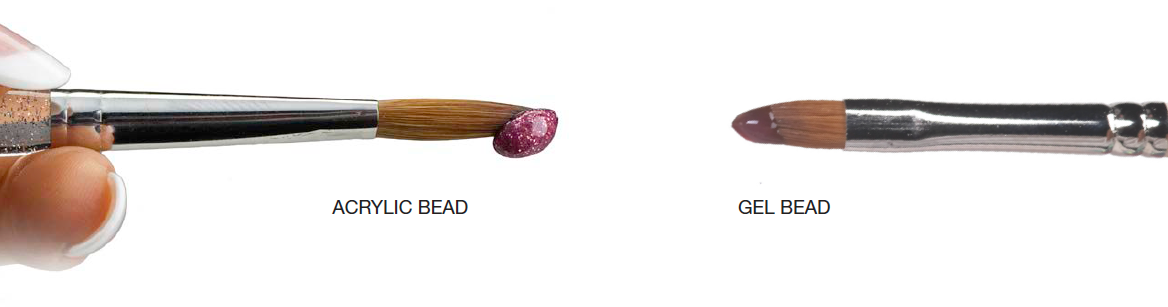
| – Acrylic nails are beautiful but do not offer that glossy finish like gel – Acrylic nails cure in ambient air and natural light once applied to the natural nail – Acrylic nails give off a strong smell during application – Acrylic nails are hard-wearing but not as flexible as gel – Acrylic nails can be filed off or soaked in acetone and buffed off – Applied using natural-hair brushes | – Gel nails have a glossy and more natural appearance on the hands – Gel nails, on the other hand, require exposure to UV or LED light cure – Gel nails are odourless – Gel nails have a natural finish and are lighter on the nails – Gel nails need to be filed off completely since the product doesn’t dissolve in acetone – Applied using synthetic brushes |
Acrylic nail chemistry
The basic chemistry of acrylic nails involves three ingredients. Liquid acrylic is a type of monomer which is a substance made up of many small molecules that are not attached to one another. In contrast, a polymer is a powder made up of molecules that are attached in long chains. Polymerisation is the chemical reaction that causes monomer and polymer molecules to link into long chains and usually form something hard, such as finished acrylic nails. A catalyst or initiator is an ingredient that triggers the hardening or curing process. The powdered acrylic used is a combination of ground up polymer and catalyst.
This polymerisation process involves an initial surface set followed by a complete cure or hardening of the product. The timing involved for this process differs from product to product, however is generally broken down into two stages referred to as ‘set-time’ (partial polymerisation, on average approx. 3 minutes) and ‘cure-time’ (full polymerisation, on average approx. 24–48 hours with 60% of the process occurring within the first hour).
Factors which effect the rate of polymerisation include:
- Warm or cold drafts: can cause rapid evaporation of the monomer, causing powder particles to remain on the surface. This is usually referred to a surface frosting.
- Cold: if monomer freezes, allow it to sit at room temperature – it can still be used.
- Heat: if monomer is left at high temperatures, partial polymerisation will take place in the bottle. This is indicated by the liquid looking and feeling more viscous. Discard the product as this cannot be used.
- Mix ratio: every product works best at its recommended mix ratio. Always follow the manufacturer’s instructions.
In addition to acrylic polymer (powder) and monomer (liquid), acrylic primers are used to treat the natural nail surface prior to treatment. These products act to remove bacteria and grease from the nail, as well as bind the keratin in the nail bed to create a stronger bond for the enhancement process. The primary ingredient is an acid, usually methacrylic acid, which is toxic and therefore should be used in strict accordance with manufacturer’s guidelines.
Gel nail chemistry
As mentioned, in contrast to acrylic products which are mixed together to initiate a chemical reaction to cure, gel products are pre-mixed and contain two primary chemical components: oligomers and photoinitiators.
Oligomer
An oligomer is a short pre-formed chain of monomers that make up the chemistry of gels. The monomers in gel are already linked to form chains. Therefore, it takes much less time for the gel enhancement to fully cure. The pre-formed oligomer chains usually cure in 1-2 minutes under a UV/LED nail lamp. With gels, you are not waiting for the individual monomers to link, and then waiting for the chains to link together.
When gels were first introduced to the nail industry in the mid 80s, the goal was to create a strong and durable enhancement parallel to acrylic with a glossy, hard finish. The base, urethane acrylate oligomers, chosen to create these gels had a tight molecular structure, resulting in a lower molecular weight. This made them highly resistant to solvents.
Photo-initiators
Photo-inititiators are molecules that initiate a chemical reaction upon absorption of light of a certain wavelength. In the case of gel nail products, this wavelength is ultraviolet (or UV for short) and the resulting chemical reaction causes polymerisation. You will recall that polymerisation is the chemical reaction that causes monomer and polymer molecules to link into long chains and form something hard, such as finished acrylic and gel nails.
The specific combination and type of photo-inititiators used in a system greatly dictate the properties of the gel, including how fast the product cures, how much heat (exotherms) is produced, and the type of light needed for proper polymerisation. The more photo-inititiators present in a formulam, the faster the cure, and the more heat it creates. If the concentration of photo-inititiators is too low, weakness, loss of adhesion and a higher chance of an allergic reaction may result.
Finding the correct chemical and, subsequently, balance of photo-inititiators used in gel chemistry are the two most difficult challenges for nail chemists. The most important factors in UV/LED curing are:
- A suitable balance between the photo-initiators and the output of the nail lamp.
- The intensity and the spectrum of available UV light.
- The duration of the light exposure.
Even with balanced photo-inititiators levels, clients can still experience heat from an exothermic reaction if the gel is applied too thick. The thicker the layer of gel, the more intense the exothermic reaction. Thick layers allow less light to reach the bottom layers, while thinner layers of gel cure more thoroughly and create less heat while curing. It is for this reason that multiple layers of gel are applied to each nail during a treatment (but more on that in Module 5!).