2.3 Nail enhancement process
Now that you have a solid understanding of the history of nails and where the industry is heading, we will finish this module off by taking a look at the nail enhancement process from end to end and introduce you to key terminology that you will use in your role as a nail technician.
When working with your clients, you will begin with the end in mind (the desired look) and will then work backwards to determine what you will need to do to achieve the end goal. Using a similar approach in your learning, it is important for you to understand what the end goal is before you can begin working towards it. The diagram below provides a simple overview of each phase of the nail service process that you will learn throughout this course:
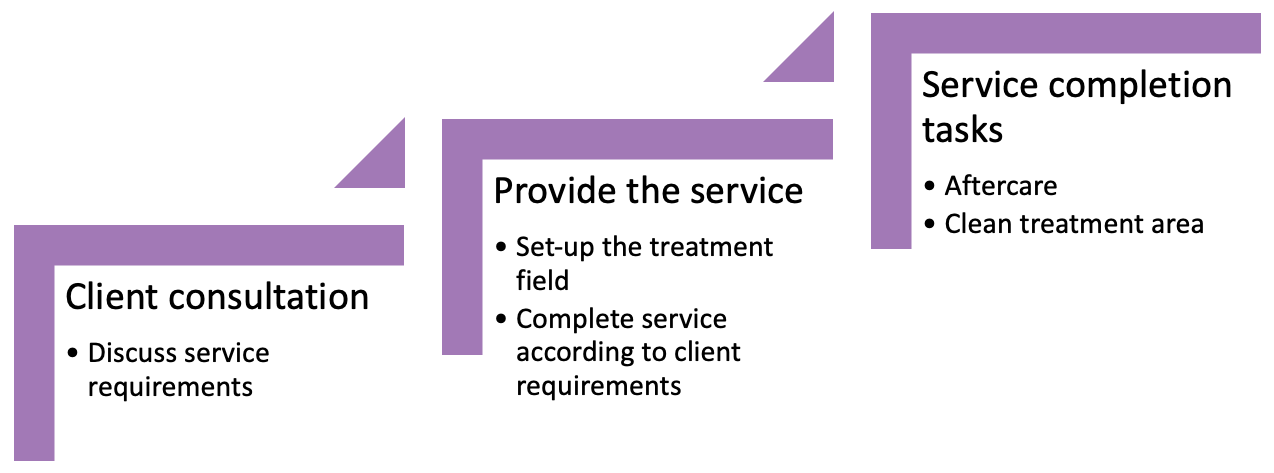
This course has been strategically designed to ensure that you begin by building your knowledge of all the processes, techniques, tools, products, and safety requirements that are critical for your role as a nail technician. Once you have a solid understanding of all of the theory components, you can then begin practising and refining the broad range of skills you will need to be successful in your role and to ensure your clients leave your treatment area happy and satisfied.
When starting out as a nail technician, it can be a bit confusing because some of the terminologies can sometimes feel like learning a new language! If terms such as onycholysis, paronychium or eponychium seem confusing to you now, fear not – by the end of this course, you will have a solid grasp of what these terms mean and how they apply in each phase of the nail enhancement process.
As a starting activity, read each of the terms and concepts below. Highlight any terms that you do not know or are unsure of:
- Abnormal skin around the nail
- Acid Mantle
- Allergic reactions
- Beau’s lines
- Blisters
- Bruised nails
- Bunions
- Calluses
- Circulatory problems
- Combination skin type
- Corns
- Corrugated furrows
- Dermatitis
- Dermatologist
- Dermatophytes Fungus
- Dermis
- Desquamation
- Disinfecting
- Distal phalanx
- Drug-induced nail changes
- Dry heat steriliser
- Dry skin type
- Eggshell nails
- Epidermis
- Eponychium (cuticle)
- Ergonomics
- Full-well tips General practitioners (GPs)
- Habit tic
- Half-well tips
- Hammertoes
- Hangnails
- Heel fissures
- Highlighting
- Hue
- Hypoallergenic
- Hypodermis
- Hypoesthesia
- Hyponychium
- Keratin
- Koilonychias
- Lunula or Half Moon
- Manicure
- Melanin
- Moist heat steriliser
- Nail bed (sterile matrix)
- Nail folds (lateral and proximal nail fold)
- Nail plate
- Nail root (germinal matrix)
- Nail tip or free edge
- Normal skin type
- No-well tips
- Oily skin type
- Onychauxis
- Onychocryptosis
- Onychodermal band Onycholysis
- Onychorrhexis
- Onychotrophia
- Orthopaedic doctor
- Paraben
- Paronychium
- Pedicure
- pH level
- Phenethyl Alcohol
- Podiatrist
- Pseudomonas
- Pterygium
- Safety data sheet
- Sanitising
- Saturation
- Sebum
- Skin exfoliation
- Skin tone
- Splinter haemorrhage
- Sterilisation, sanitisation and sanitation
- Stratum corneum
- Stratum germinativum (basal layer)
- Stratum granulosum
- Stratum lucidum
- Stratum spinosum
- Tonal value
- Undertone
- UV light steriliser Work life balance
We will revisit this list at the end of the course to see how many you have mastered!