Module 3 Progress Quiz
The following quiz is designed to test your comprehension and retention of the learning material contained in Module 3: Foundation knowledge.
You must achieve a score of 75% to pass this quiz. You may retake this quiz as many times as required to achieve the pass mark.
Quiz Summary
0 of 11 Questions completed
Questions:
Information
You have already completed the quiz before. Hence you can not start it again.
Quiz is loading…
You must sign in or sign up to start the quiz.
You must first complete the following:
Results
Results
0 of 11 Questions answered correctly
Your time:
Time has elapsed
You have reached 0 of 0 point(s), (0)
Earned Point(s): 0 of 0, (0)
0 Essay(s) Pending (Possible Point(s): 0)
Categories
- Not categorized 0%
-
Unfortunately, you have not achieved the pass mark of 75%. Please select Restart Quiz to try again.
-
Congratulations, you have passed this quiz!
- 1
- 2
- 3
- 4
- 5
- 6
- 7
- 8
- 9
- 10
- 11
- Current
- Review
- Answered
- Correct
- Incorrect
-
Question 1 of 11
1. Question
The skin across different parts of our body changes; some surfaces can have thin layers, thick layers and another part can be hairy. Regardless of which part of the body, our skin is divided into three layers called the epidermis, the dermis and the subcutis. Match each skin layer to the correct main roles.
Sort elements
- Makes new skin cells, creates our skin tone and protects the body.
- Makes sweat and oil, provides sensations and blood to the skin and grows hair.
- Attaches dermis to the body, controls body temperature, stores fat, cushions the internal organs against shocks and separates the skin from underlying muscles.
-
Subcutis (subcutaneous or hypodermis)
-
Epidermis
-
Dermis
CorrectIncorrect -
Question 2 of 11
2. Question
Our client’s skin type will impact the types of products we select. Match each skin type to the typical indicators you will need to look for when determining your clients’ skin type.
Sort elements
- Fine pores, good blood circulation, soft and smooth texture, no blemishes and no sensitivities.
- Enlarged and clearly visible pores, blackhead and whiteheads, glossy shine and acne.
- Mild scaling or flakiness in patches, a rough and blotchy appearance, a feeling of tightness, possible itchiness and sensitivities.
- An oily T-zone (forehead, chin and nose), enlarged pores in this area, perhaps with some impurities and normal to dry cheeks.
- Thinning, dryness, wrinkle's, age spots and skin tags.
-
Oily
-
Combination
-
Mature
-
Normal
-
Dry
CorrectIncorrect -
Question 3 of 11
3. Question
While it is not our role to diagnose conditions, there are some contraindications that we will be able to visually identify. Match each client example shown to the most likely contraindication.
Sort elements
- Cuts or open wounds in the region of the eyes or recent eye surgery
- Evidence of eye inflammation or infection
- Dry eyes syndrome
- Cold sores
- Oily or acne-prone skin
CorrectIncorrect -
Question 4 of 11
4. Question
One of the best ways to pre-empt and prevent contra-actions related to allergies is to conduct a patch test. You may decide to conduct patch tests on all clients prior to applications, but you must definitely do so if a client advises you they have sensitive skin or are prone to allergies. The purpose of the patch test is to test products to ensure there are no reactions to any of the ingredients.
Reorder the tasks listed in order of what comes first to what comes last in the patch test process.
-
If no reaction occurs it is fine to proceed with the application
-
If any contra-actions occur such as redness, swelling, inflammation or itching, avoid using the product as this is a positive reaction for sensitivity
-
Apply a small amount of intended products you wish to use with a cotton bud to the inner crease of the elbow, behind the ear, inside of the wrist, or inside the leg
-
Leave for 24 to 48 hours
CorrectIncorrect -
-
Question 5 of 11
5. Question
No two clients are the same, and you will likely encounter a broad range of face shapes on any given day. Match each face shape to the correct common features.
Sort elements
- Full cheeks, rounded chin, equal length and width. Celebrity hint: Drew Barrymore has this face shape.
- Prominent jawline, angular features and wide forehead. Celebrity hint: Sandra Bullock has this face shape
- Balanced features, high cheekbones and narrow chin. Celebrity hint: Beyonce has this face shape
- Broad forehead, pointed, narrow chin and high cheekbones. Celebrity hint: Eva Longoria has this face shape
- Long, slender face, long nose and high cheekbones and tall forehead. Celebrity hint: Sarah Jessica Parker has this face shape
- Narrow and parallel eyes, broad/full cheeks and a narrow jawline. Celebrity hint: Megan Fox has this face shape
CorrectIncorrect -
Question 6 of 11
6. Question
Which of the following are contraindications where you would have to refuse service? Select two correct responses.
CorrectIncorrect -
Question 7 of 11
7. Question
Primers and foundations are either silicone, water or oil-based. When applying these products, it pays to look at the ingredients list to work out what base you are working with. As a general rule, if your foundation contains silicone (most likely), then make sure that oil is in your primer and/or moisturiser.
CorrectIncorrect -
Question 8 of 11
8. Question
Cosmetic chemistry is a science in itself, so you are not expected to know every single ingredient off by heart. If you are unsure of what an ingredient is, what can you do? Select four correct responses.
CorrectIncorrect -
Question 9 of 11
9. Question
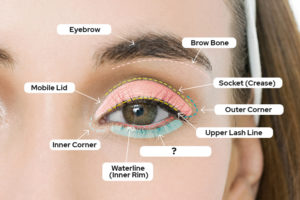
Identify the missing component of the eye:
CorrectIncorrect -
Question 10 of 11
10. Question
Knowing which colours work best with your own skin tone and undertone is an excellent place to start when learning to apply colour theory professionally. Match each skin tone with the most appropriate colours will be most complementary.
Sort elements
- Dark brown, burgundy, grey, blues, deep purples, lavender, lilac, sapphire, and emerald greens.
- Dusty pink, soft rose, peach, jade green, taupe, grey, off-white and blue.
- Orange, red, golden yellow, amber, warm greens, blue, turquoise, moss green, magenta, purple, chocolate brown and creamy whites.
- Purple, pink, peach, orange, yellow, jade green, cobalt blue and bright colours in general.
-
Dark skin
-
Olive skin
-
Fair and light skin
-
Medium skin
CorrectIncorrect -
Question 11 of 11
11. Question
Match each eye image to the correct eye shape.
Sort elements
- Wide-set
- Close-set
- Hooded
- Monolid
- Downturned
CorrectIncorrect


